

Material, Culture, and the Value of What Endures
By Helle Fog
In today’s building industry, materials are often chosen for speed, price, and standardisation. Surfaces are expected to be uniform, predictable, and easy to replace.
But architecture is not only about efficiency.
It is also about atmosphere, longevity, and the quiet presence of materials that age with dignity.
At Villa, we work with handmade tiles not as a nostalgic alternative, but as a material choice rooted in something deeper — a combination of historic craftsmanship, material logic, and cultural continuity.

A Material That Is Not Just a Surface
Many modern surface products are built as systems: layers, coatings, prints, and finishes applied to achieve a certain look.
Handmade cement tiles — also known as encaustic or marble-cement tiles — are fundamentally different.
They are solid, mineral materials, manufactured in a traditional two-layer technique developed in Europe in the mid-19th century:
- A coloured wear layer of marble powder, white cement, and mineral pigments
- A structural base layer of sand and cement
There is no surface film. No printed pattern. No artificial coating.
The surface is the material itself.
This gives the tile a different kind of presence — one that feels grounded, honest, and architectural.
Craft Is Not About Imperfection — It Is About Control
Handmade is often misunderstood as something irregular or imprecise.
In reality, working with handmade cement tiles requires a high level of control — both in production and in design.
Each tile is formed, pressed, and cured by hand. Subtle variations in tone and surface emerge naturally from the process, creating a depth that cannot be industrially replicated.
At the same time, the tiles are manufactured with high dimensional precision, allowing:
- Narrow joints
- Calm, continuous surfaces
- Architectural clarity
This balance between precision and variation is where the material comes alive.
Not as a perfect repetition — but as a coherent surface with character.
From European Heritage to Contemporary Nordic Design
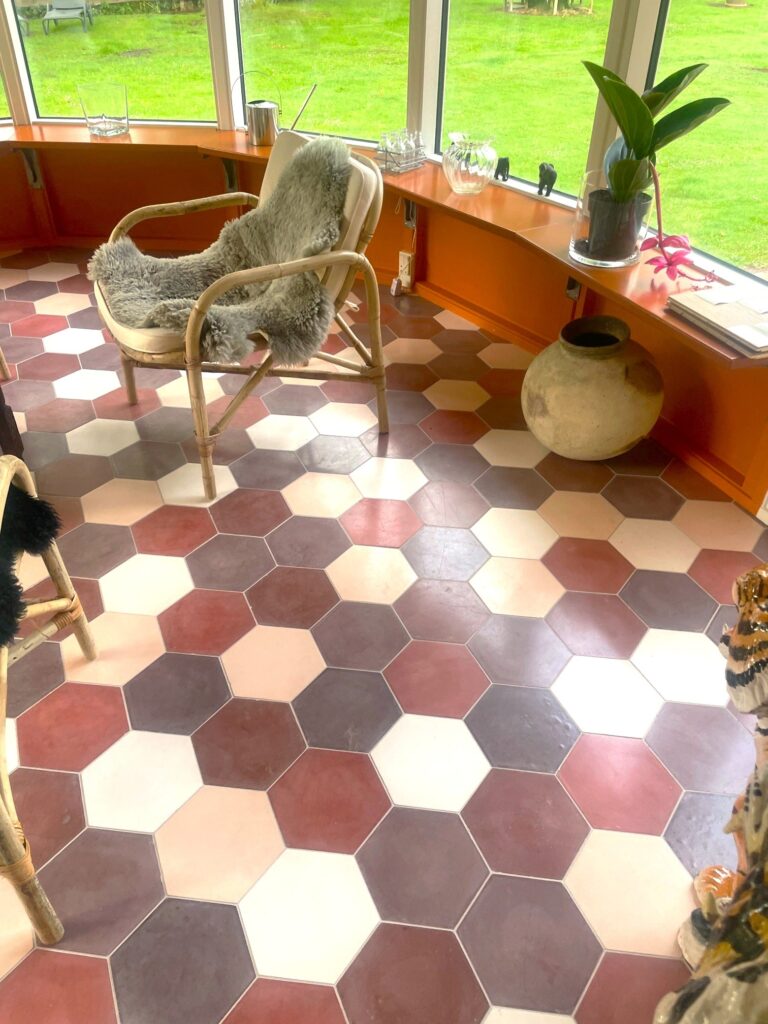
Handmade cement tiles have a long history in Europe, including Denmark, where they were widely used from the late 1800s until the mid-20th century. Many of these floors still exist today — not as relics, but as functioning parts of buildings.
This historical durability is not an abstract claim. It is built into the material.
At Villa, this tradition forms the starting point — but not the end.
Our work is about continuing and evolving the material, not reproducing the past.
- Classic patterns are reinterpreted in Nordic colour palettes
- New geometries and formats are developed for contemporary architecture
- Functional innovations expand the material’s use in modern building systems
The result is not historical imitation, but a dialogue between past and present.
A Journey Between Cultures
The story of Villa is also a story of movement — between North and South, between traditions and new ideas.
For more than two decades, the work has been shaped through close collaboration with craftsmen south of the Mediterranean, particularly in Morocco, where historic craft traditions are still alive.
Here, techniques developed in Europe in the 1800s have been preserved, adapted, and carried forward.
In these workshops, the material is not abstract. It is physical, direct, and shaped by hand.
This meeting between:
- Southern craftsmanship and cultural richness
- Nordic clarity and design discipline
forms the foundation of Villa’s expression.
Each tile becomes part of that exchange — a small piece of a much larger story.
Innovation Within the Craft
Working with traditional techniques does not mean standing still.
At Villa, development happens from within the material and the craft itself.
This has led to new types of handmade cement tiles and systems that extend the traditional cement tile into contemporary use:
- Curved and coved tiles for seamless transitions
- Integrated slip-resistant surfaces without coatings
- Outdoor tiles adapted to Nordic climate conditions
- Custom formats and coordinated elements for full architectural solutions
These developments are not added layers — they are integrated into the material logic.
Designed to Last — Not to Be Replaced
Perhaps the most important difference between handmade cement tiles and many modern materials is time.
Most surfaces today are designed with replacement in mind.
Cement tiles are not.
With a solid wear layer of marble and cement, the surface can be:
- Maintained
- Refinished
- Repaired locally
Rather than replaced.
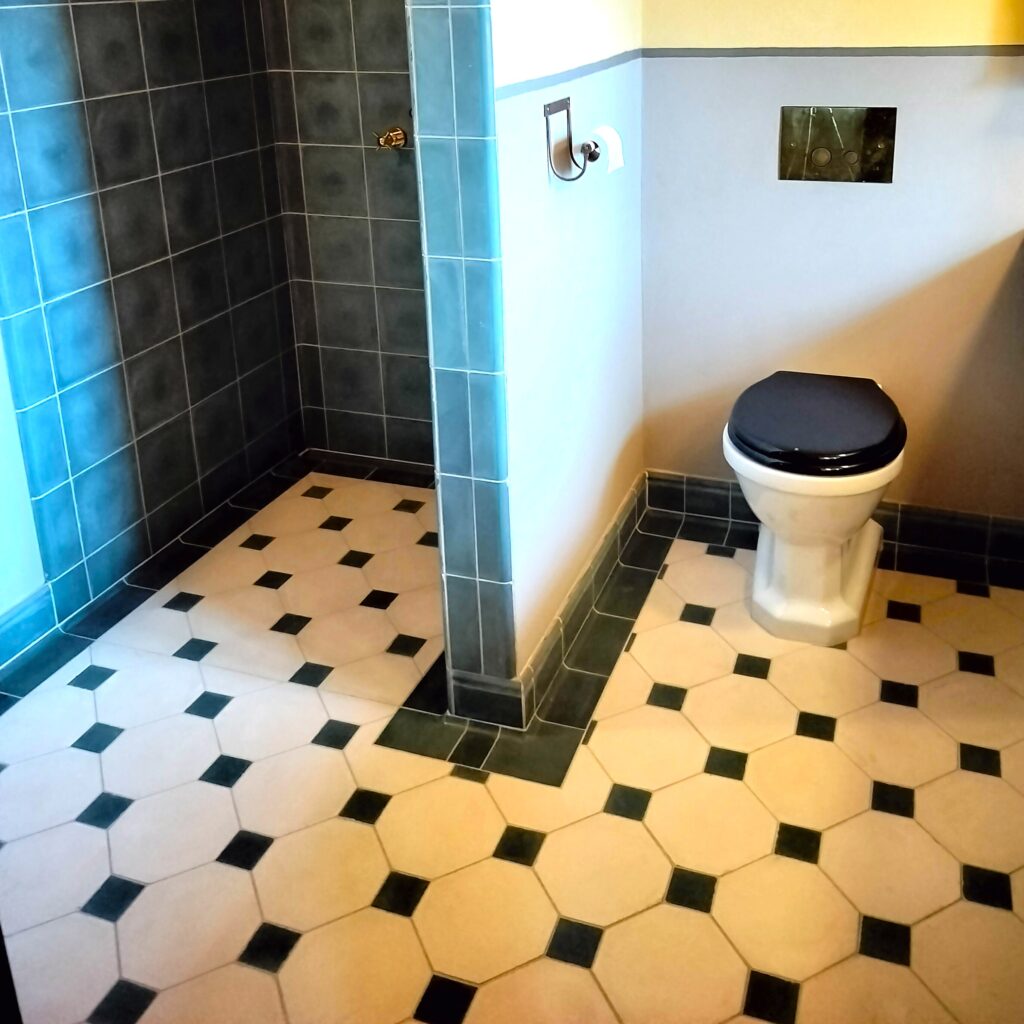
With a documented lifespan of more than 130 years, the material shifts from being a consumable product to becoming part of the building itself.
In a time where the construction industry is under pressure to reduce waste and extend lifecycles, this changes the perspective entirely.
A Different Approach to Sustainability
Sustainability is often reduced to certifications and calculations.
But it also begins with fundamental choices:
- What materials we use
- How they are made
- How long they last
Handmade cement tiles contribute through:
- Cold production, without energy-intensive firing
- Pure mineral composition, without synthetic layers
- Long lifespan, reducing the need for replacement
- Repairability, extending functional use over time
Equally important is the human dimension.
Keeping craftsmanship alive is not only about tradition — it is about maintaining knowledge, skills, and cultural continuity across generations and geographies.
Why It Still Matters
In a world of mass production, handmade cement tiles are not the easiest choice.
They require more thought. More dialogue. More intention.
But they offer something that industrial materials often cannot:
- A sense of origin
- A connection between material and maker
- A surface that carries time, not just function
At Villa, we do not see handmade tiles as a niche product.
We see them as a relevant material for contemporary architecture — precisely because they combine durability, material honesty, and cultural depth.
Because in the end, the materials we build with shape not only our spaces — but how those spaces are experienced, used, and remembered.
About Villa
Villa Tiles develops and manufactures handmade cement tiles based on historic European techniques, refined through Nordic design and long-term collaboration with skilled craftsmen.
Working across cultures and disciplines, we create tiles that are not only surfaces — but lasting parts of architecture.


Leave a Reply