
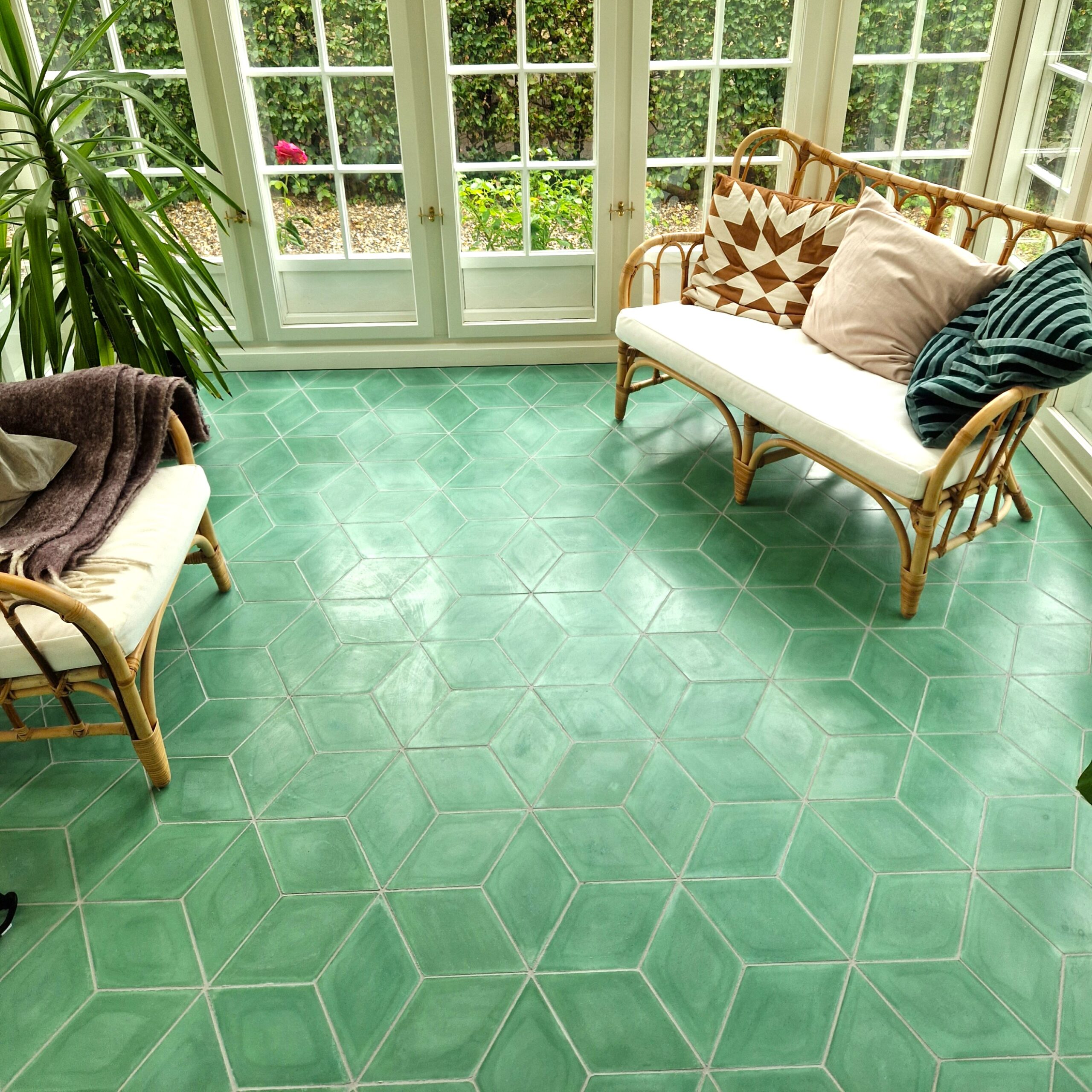
Understanding the materials, manufacturing methods, surfaces, longevity and design possibilities behind two very different types of tile.
By Helle Fog
When choosing tiles for a home, hotel, restaurant or architectural project, the visual appearance is often the first thing we notice.
But two tiles can look surprisingly similar while being made from completely different materials.
This is particularly true when comparing handmade cement tiles with ceramic or porcelain tiles. A patterned cement tile and a patterned ceramic tile may appear similar from a distance, but their material composition, manufacturing process, surface, ageing and possibilities for maintenance are fundamentally different.
At Villa Tiles, we work primarily with handmade marble-cement tiles, also known internationally as handmade encaustic cement tiles or hydraulic cement tiles. They belong to a European tile tradition that developed in the mid-19th century and became widely used across Europe around the turn of the 20th century.
Our work begins with this historic material tradition, but does not end there. We develop our own colours, patterns, shapes and technical solutions, combining traditional craftsmanship with a distinctly Nordic design approach.
So what actually is the difference between a cement tile and a ceramic tile?
The answer begins with how they are made.
Cement tiles and ceramic tiles are made in fundamentally different ways
The simplest distinction is this:
Ceramic tiles are made from clay or mineral-based ceramic bodies and hardened through firing in a kiln. Handmade cement tiles are formed under pressure and cured hydraulically, without firing.
That difference affects almost everything about the finished material.
A traditional handmade cement tile is made individually using a mould and pressure. The coloured surface is created from a mixture of marble powder, white cement and mineral pigments. A structural layer of cement and sand is then added before the tile is pressed.
The tile subsequently cures through the reaction between cement and water, rather than being fired.
This is why the term hydraulic cement tile is used internationally. Hydraulic refers to the way the cement-based material hardens through its reaction with water, rather than through a firing process. It is the same fundamental meaning of hydraulic used when referring to materials such as hydraulic lime.
The result is a solid, mineral tile with a characteristic matte surface.
Ceramic tiles follow a different route. The ceramic body is shaped, dried and fired at high temperatures. Depending on the product, the surface may then be glazed, printed or otherwise finished.
Neither method is inherently “right” or “wrong”.
They simply create different materials with different qualities.
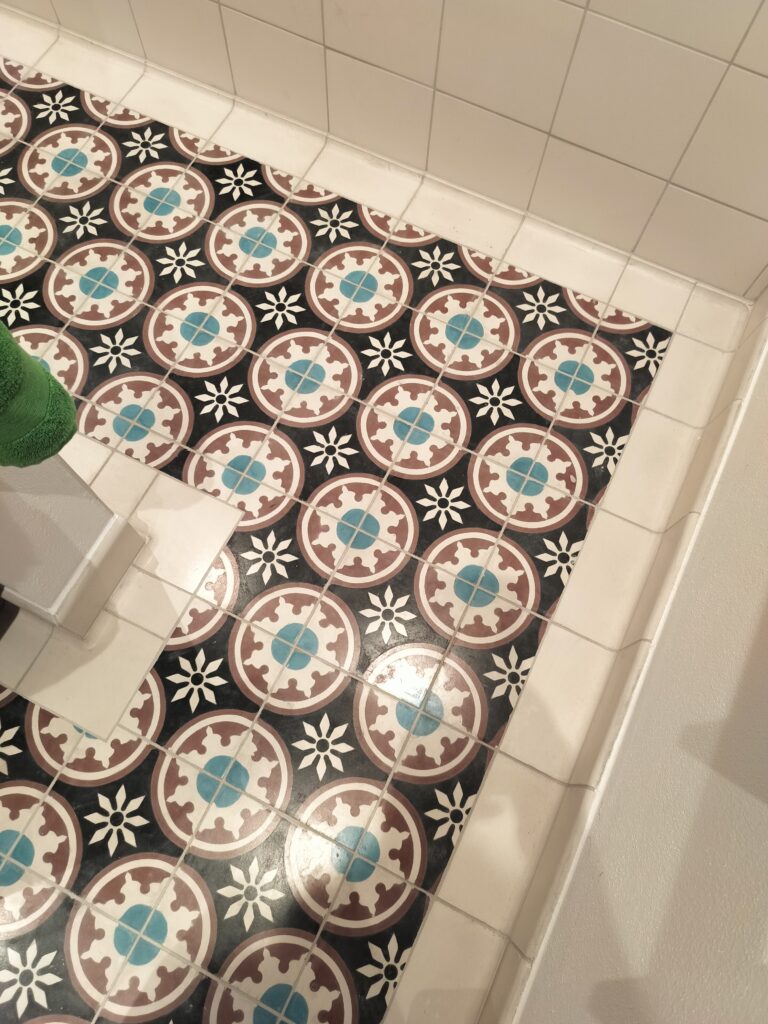
What is a handmade encaustic cement tile?
The terminology surrounding these tiles can be confusing.
A cement tile, hydraulic tile or encaustic cement tile generally refers to the same broad family of handmade, hydraulically cured cement tiles.
The word encaustic has a much older history, however, and has also traditionally been used for decorative fired-clay tiles where coloured material is inlaid into the body of the tile. In today’s international tile market, encaustic cement tile is widely used to describe the handmade, hydraulically cured cement tile with a coloured mineral wear layer.
At Villa, our handmade encaustic cement tiles are made using a two-layer construction.
The upper layer contains:
- marble powder
- white cement
- mineral pigments
This is the visible wear layer and contains the colour and pattern.
Beneath it is a strong structural layer made from cement and sand.
The important point is that the colour is not simply printed onto the surface.
The coloured layer is the surface.
There is no ceramic glaze and no photographic print covering the design.
This gives cement tiles their characteristic depth, soft matte appearance and ability to develop a natural patina as they age.
The surface is part of the material
This is perhaps one of the most important differences between handmade cement tiles and many contemporary ceramic tiles.
With a glazed ceramic tile, the visible surface is a separate fired glaze. With digitally printed ceramic or porcelain tiles, a decorative image may be applied to the surface and protected by a finish.
With a handmade cement tile, the coloured mineral material itself forms the wear layer.
That distinction matters over time.
The surface can gradually acquire traces of use while remaining part of the same material. If the surface becomes worn or damaged, the cement tile can be sanded and refinished rather than simply discarded.
This is one of the reasons historic cement tile floors can develop such a particular character.
They do not necessarily become less interesting as they age.
They become part of the history of the building.
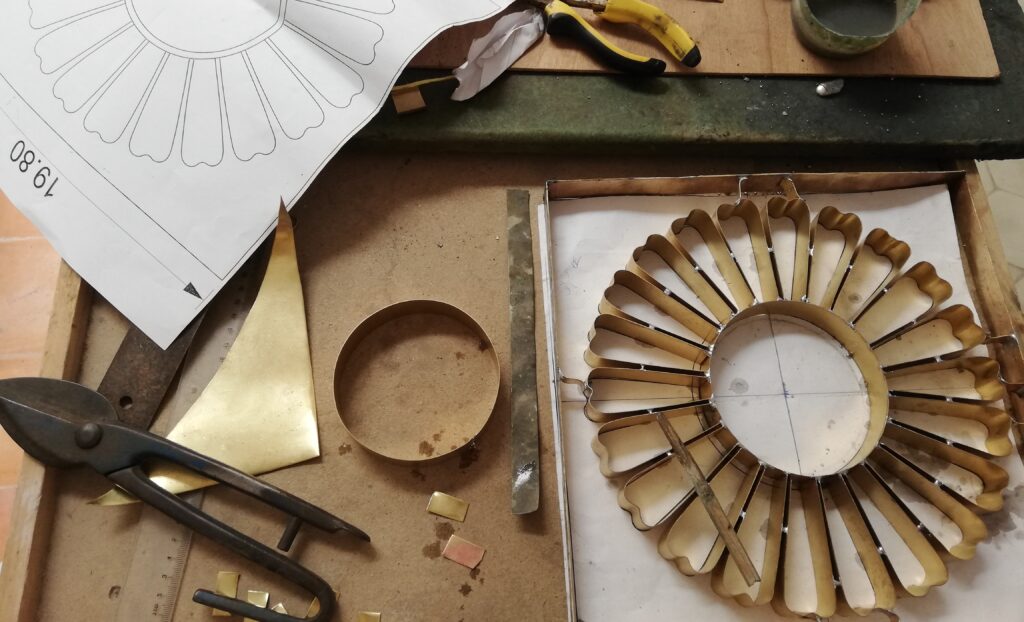
Handmade does not mean imprecise
Another important difference is the relationship between craftsmanship and variation.
Industrial ceramic production is designed around highly controlled repetition. Every tile is intended to be as identical as possible.
Handmade cement tiles have a different expression.
Each tile is individually produced. Small variations in colour, tone and surface are a natural consequence of the handmade process.
But that does not mean that the tiles are randomly made.
Quite the opposite.
Producing a good handmade cement tile requires considerable control of the materials, moulds, proportions, pressure and curing process. At Villa, dimensional precision is particularly important because it allows the tiles to be laid with narrow joints and used to create calm, continuous architectural surfaces.
The result is a balance between precision and variation.
That balance is one of the qualities that distinguishes a genuinely handmade material from an industrial imitation of one.
Pattern is created differently
The difference becomes particularly interesting when comparing patterned tiles.
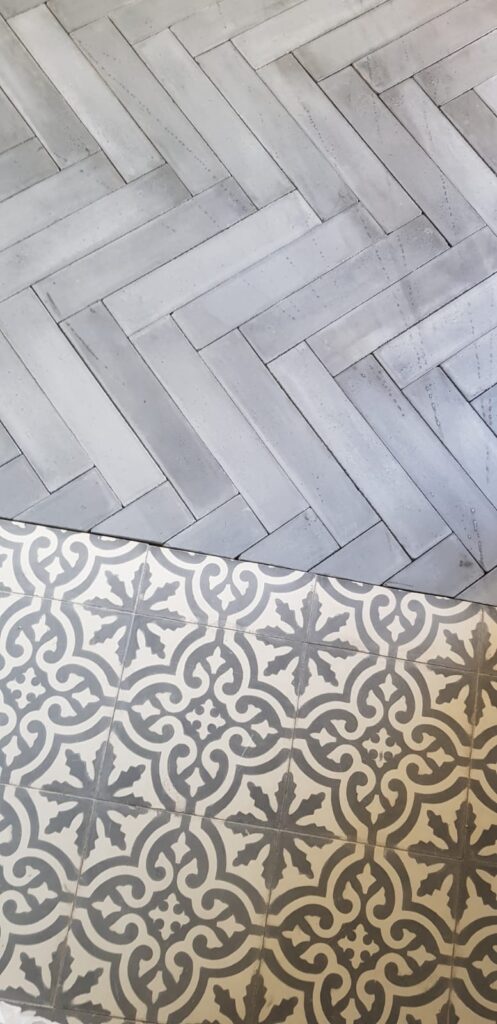
In a handmade encaustic cement tile, the pattern is created within the coloured cement layer using a specially made mould. Different mineral colours are placed into the mould before the tile is pressed.
The pattern is therefore integrated into the material.
With many patterned ceramic or porcelain tiles, the appearance is instead created through glazing or digital printing and then fixed through firing.
The two approaches can produce visually similar results.
But they do not create the same material.
This is also why a ceramic tile designed to look like a cement tile should not be confused with an actual cement tile.
One reproduces the appearance.
The other is the material.
A long European tradition
Handmade cement tiles emerged in Europe during the 19th century and became particularly widespread from the late 1800s into the first decades of the 20th century. They were used extensively in homes, public buildings and commercial interiors.
The material also became part of Danish architectural history.
Many historic cement tile floors in Denmark have survived for generations and remain in use today.
For Villa, this history is an important starting point.
But our intention is not to recreate a historical product catalogue.
Instead, we ask what can happen when an old material tradition is viewed through a contemporary Nordic design perspective.
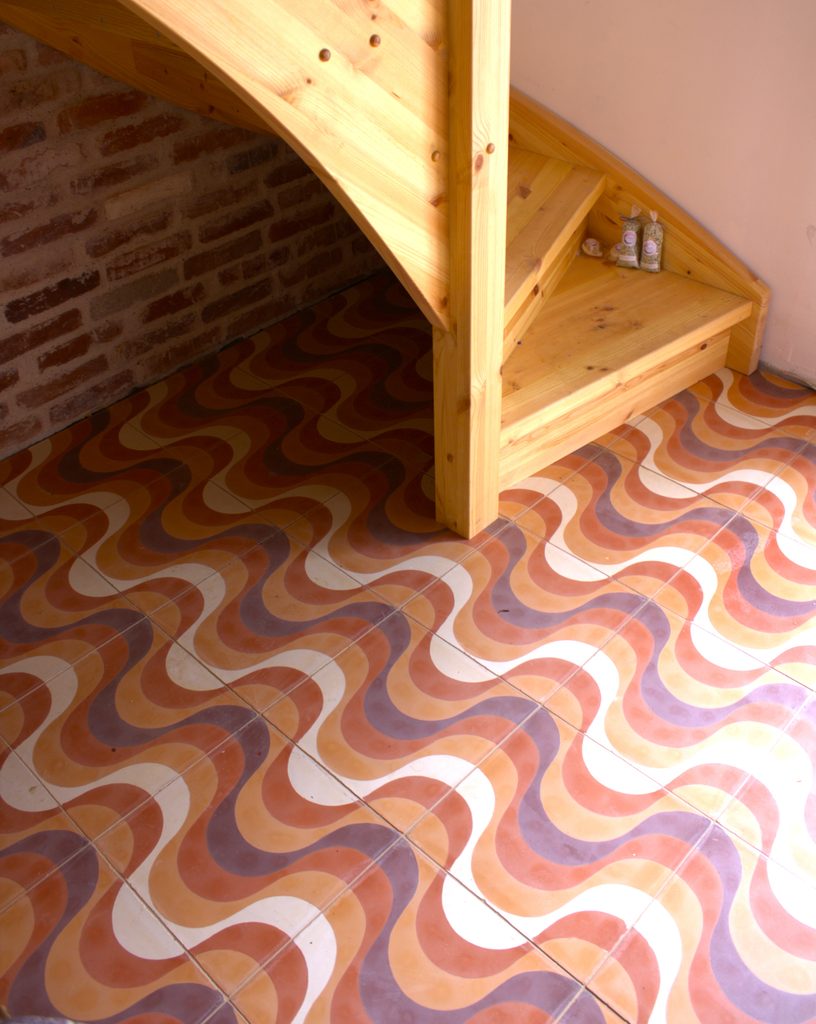
From traditional patterns to Villa’s own design language
This is where Villa’s approach differs from simply reproducing traditional cement tiles.
Our collections include classic patterns, but we also develop our own colours, patterns and tile shapes.
The colour palette is deliberately Nordic, with restrained and natural tones designed to work with contemporary architecture.
And the development goes beyond colour and decoration.
New shapes and functional tile types have been developed to extend what handmade cement tiles can do as an architectural material.
These include:
- coved tiles for integrated floor-to-wall transitions
- curved and edge elements
- integrated slip-resistant surfaces
- outdoor cement tiles developed for Nordic conditions
- custom-made shapes and coordinated architectural elements
The aim is not to make handmade tiles look modern for the sake of it.
It is to make the material more relevant to the way architecture is designed and built today.
What happens as the tiles age?
This is another area where the difference between cement and ceramic becomes important.
A ceramic or porcelain tile is generally designed to retain its original surface for as long as possible. Once the surface is damaged beyond repair, the tile normally needs to be replaced.
A handmade cement tile has a different relationship with wear.
Its mineral wear layer can be:
- maintained
- sanded
- refinished
- locally repaired
The material can therefore remain in use even as its surface changes.
This is one reason Villa develops its cement tiles with a long-term perspective. The intention is for the tile to become part of the building rather than a surface product with a predetermined replacement cycle.
Historic examples demonstrate the potential of this approach: cement tile floors installed more than a century ago can still be found in European buildings today.
What about durability?
Both ceramic and cement tiles can be highly durable.
The relevant question is therefore not simply:
Which tile lasts longest?
It is:
How does the material behave throughout its life?
Ceramic and porcelain tiles are fired and can provide excellent resistance to wear, moisture and staining, depending on their composition and surface treatment.
Handmade cement tiles are solid mineral materials with a relatively thick wear layer. Their longevity is closely connected to the ability to maintain and renew that layer.
For a building designed to last for generations, this distinction matters.
A material that can be repaired and renewed offers a different relationship with time than one designed primarily to remain unchanged until replacement.
Cement tiles, ceramics and sustainability
Sustainability comparisons between materials are rarely as simple as choosing one material and declaring it “green”.
Cement itself has a significant environmental footprint, and this should not be ignored.
The relevant question is therefore the complete material and lifecycle.
Handmade cement tiles have several characteristics that are relevant when considering their lifecycle:
No kiln firing:
The tiles cure through water and air rather than being fired at high temperatures.
Mineral composition:
The material is based on cement, sand, marble powder and mineral pigments rather than plastic-based surface layers.
Long service life:
The tiles are developed for a lifespan of more than 100 years and, with appropriate maintenance, can remain functional for considerably longer.
Repair and refinishing:
The surface can be renewed rather than replacing the entire tile.
Efficient use of marble:
In the two-layer construction, the marble-based material is concentrated in the wear layer where it is needed rather than throughout the entire tile.
This is part of Villa’s material philosophy: sustainability is not considered only at the point of manufacture, but also through durability, maintenance, repairability and resource use over the lifetime of a building.
So, which should you choose?
There is no universal answer.
Ceramic and porcelain tiles are highly versatile materials with their own strengths. They can be the right choice for many applications, particularly where specific technical requirements, formats or surface properties make them appropriate.
Handmade cement tiles offer something different.
They are particularly compelling when the project calls for:
- a solid, mineral material
- a matte and tactile surface
- integrated colour and pattern
- handmade character
- long-term repairability
- historical material authenticity
- bespoke colours, shapes or patterns
- a strong relationship between material and architecture
The choice should therefore begin with the character and requirements of the project rather than with the assumption that one tile type is universally superior.
The difference is more than appearance
At first glance, a ceramic tile and a handmade cement tile may seem like two versions of the same thing: a hard surface covering with a colour or pattern.
But once you look beneath the surface, they tell very different stories.
One is shaped by clay, minerals and fire.
The other by cement, marble, pigments, pressure, water and the hands of the maker.
One is designed around the consistency of industrial production.
The other embraces the balance between precision and natural variation.
And one of the most interesting qualities of handmade cement tiles is that the material itself remains visible throughout that story.
At Villa, this is what makes the material worth continuing to develop.
We are not interested in making handmade tiles simply because they are old.
We are interested in what this old material can become when craftsmanship, Nordic design and contemporary architectural needs meet.
That is why we continue to develop our own colours, designs, shapes and technical solutions — while preserving the fundamental material character that made cement tiles relevant in the first place.
Handmade cement tiles for contemporary architecture
Villa Tiles develops and manufactures handmade marble-cement tiles using historic European techniques and a contemporary Nordic design approach.
Our handmade encaustic cement tiles and hydraulic cement tiles are made for private homes, architects, designers, hospitality projects, restoration and other architectural applications.
Explore the collection, colours, patterns and shapes:
– Handmade Cement Tiles / Encaustic Cement Tiles
– Colours & Nordic Colour Palette
– Patterns & Designs


Leave a Reply